Pride 2026: “In the free trade zone sector, unions are introducing anti-discrimination clauses to protect LGBTIQ+ workers,” Eulogia Familia
This article is part of a series commissioned by the CGU LGBTI Committee to mark Pride 2026, celebrating the diversity of LGBTI workers and exploring issues of inclusion, representation and equality in the workplace and within trade unions.
- Read this in:
- en
My name is Eulogia Familia (Gina), and I am the vice president of the Dominican Republic's Unidad Sindical de Mujeres Activas (UNISIMAS/CNUS/CSA), an organisation affiliated with the International Trade Union Confederation (ITUC).
In the union, all workers participate openly as members with equal rights to treatment and inclusion without having to express any identity other than their employment status. Those who publicly identify as something other than employees rarely have many opportunities to access formal employment.
Our country’s constitution stipulates that there shall be no discrimination on the grounds of gender, social status or personal circumstances, amongst others. The Labour Code, currently undergoing reform, has been introduced into negotiations; in addition to rejecting other forms of discrimination in the workplace, it addresses discrimination on the grounds of sexual orientation. However, the Criminal Code is a different matter, as despite our efforts, it was not possible to include this provision.
The Dominican Republic has a very conservative environment, and both reforms have taken place in this sphere, which is subject to congressional and executive control by a conservative political establishment, with decisive influence from ultra-conservative factions.
We managed to include sexual orientation in the Labour Code because it was the result of tripartite and concerted negotiations, meaning that Congress had little scope to spark external debates with conservative sectors of society.
The UNISIMAS/CNUS Gender Department is responsible for organising, advising on, assisting with and advocating for inclusion policies for vulnerable workers.
To tackle discrimination against LGBTIQ+ workers, we have set up a 'Support Group for LGBTIQ+ Workers'. This group comprises representatives from organisations within the confederation that are best placed to address this issue, including those from the free trade zone, tourism and hospitality, food, mining and women's groups. The group also includes leaders who have raised awareness, as well as workers who identify as LGBTIQ+. We also consult with professionals from the LGBTIQ+ sector within civil society.
Initially, the working group was set up with support from the Friedrich Ebert Foundation, Public Services International (PSA) and the CSA, but its activities have been scaled back due to the trade unions’ limited financial capacity to continue training, particularly as this is an issue that has not yet been fully established within our organisations and we need to rely on campaigns and training to build capacity in this area.
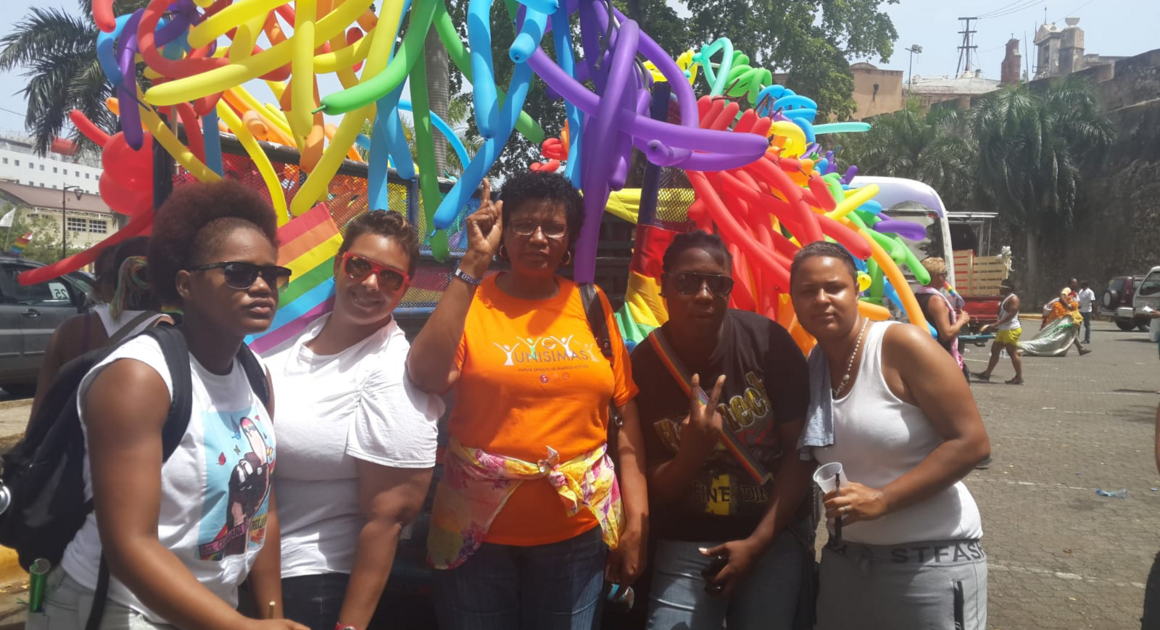
In the meantime, however, UNISIMAS incorporates the rights of this group of workers into its training activities; we have distributed leaflets against discrimination at the Pride march, and on one occasion the president of UNISIMAS was a patron of the Pride march. We provide guidance to trade unions engaged in collective bargaining to ensure they take into account the rights of LGBTIQ+ workers, particularly regarding violence and harassment. We promote ILO Conventions 190 against violence and harassment, 100 and 111 against inequality and discrimination, 156 on work-life balance, and 183 on maternity/paternity.
We participate in all union activities, paying dues, attending meetings, taking part in protests, forming alliances for human and labour rights, supporting progressive political change, attending seminars and workshops, and demonstrating solidarity and persistence in the political and trade union struggle.
In the free trade zone sector, trade unions are introducing anti-discrimination clauses that include LGBTIQ+ workers.